Application Guide
Machine Tending Automation Guide
Machine tending automation connects robots, grippers, fixtures, part presentation and machine interfaces into one production workflow. The hardware matters, but the project succeeds or fails based on how well the entire process is defined.
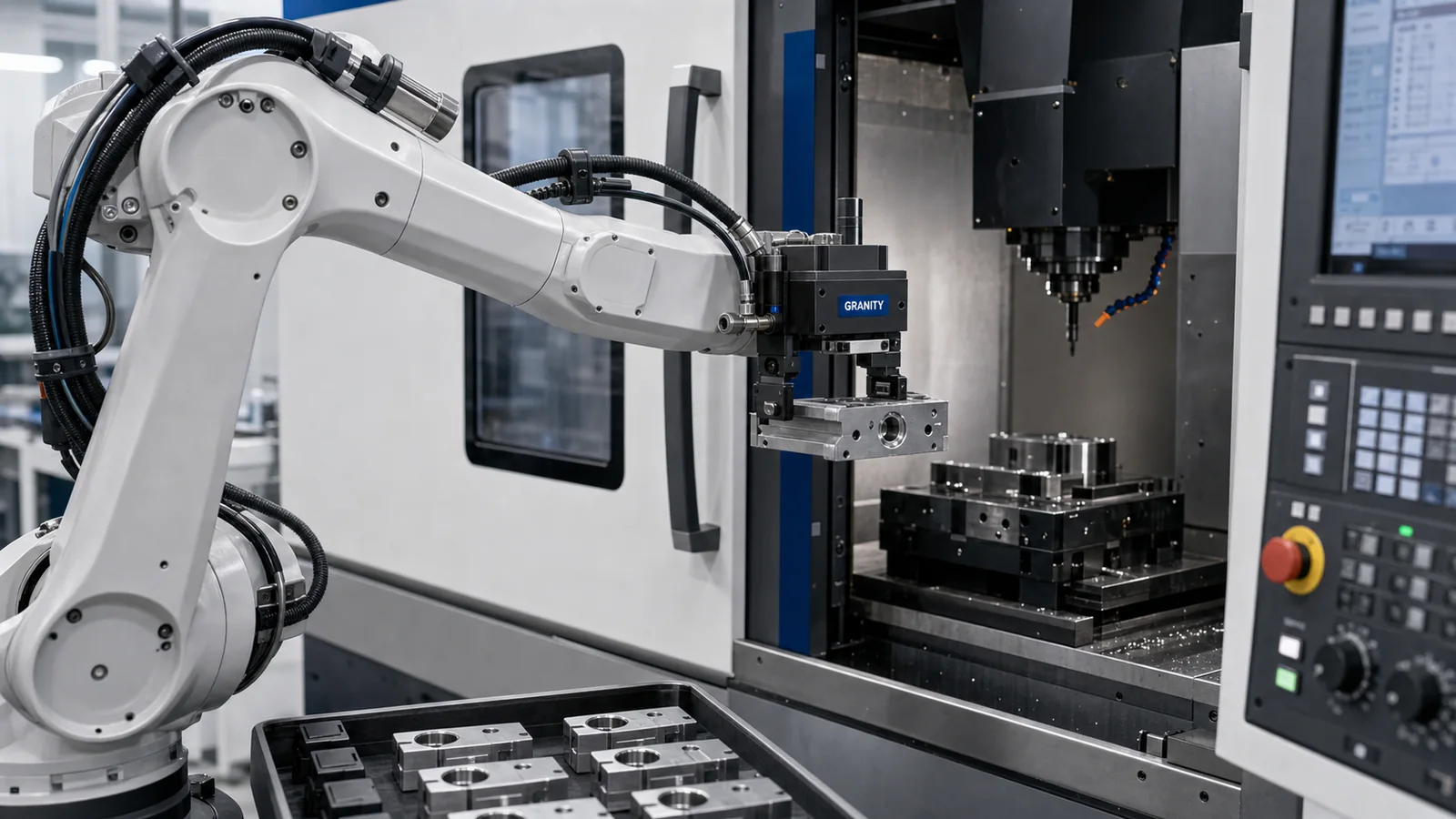
This article gives engineering and operations teams a structured way to prepare a machine tending discussion. It does not claim universal productivity gains or cycle-time savings. Every project depends on the machine, workpiece, handling method and process constraints.
1. Define the process boundary
Start by defining exactly what the automation must do. Does the robot load raw blanks, unload finished parts, flip parts between operations, clear chips, operate a door, press a button, scan a code, move trays, or transfer parts to inspection? Machine tending is not one task. It is a sequence of physical actions and confirmations.
Draw the start and end of the automation responsibility. If an operator still prepares trays, cleans fixtures or inspects parts, note that. Clear boundaries prevent unrealistic expectations and help identify where automation provides value.
2. Understand the workpiece flow
Workpiece flow includes input presentation, pick position, orientation, grip surface, movement path, machine loading position, machining or process time, unloading method and output location. A reliable gripper cannot compensate for unstable part presentation or inconsistent orientation.
Provide drawings or images of the workpiece in both raw and finished states. If surfaces change after machining, the gripper may need to handle different geometry or use different contact points. If chips, coolant or burrs are present, include that information.
3. Choose the right gripping strategy
Machine tending often uses parallel grippers, angular grippers, centric grippers, custom jaws, vacuum systems or combinations of tools. The selection depends on part geometry, mass, orientation, material and available clearance. Some projects need dual grippers so the robot can unload a finished part and load a raw part in one machine visit.
The gripping strategy should be discussed together with part presentation and machine access. A gripper that works on a bench may not work inside a tight CNC machine if jaws collide with fixtures, doors or tooling.
4. Review machine access
Machine access includes door opening, table or chuck position, fixture clearance, robot reach, safe approach angle, chip accumulation and part release path. A machine that was designed for manual loading may require additional review before automation.
State whether the door is automatic, whether there is a robot interface, whether clamping is manual or automatic, and whether the machine can provide cycle completion signals. If these details are unknown, they should be identified before committing to a hardware list.
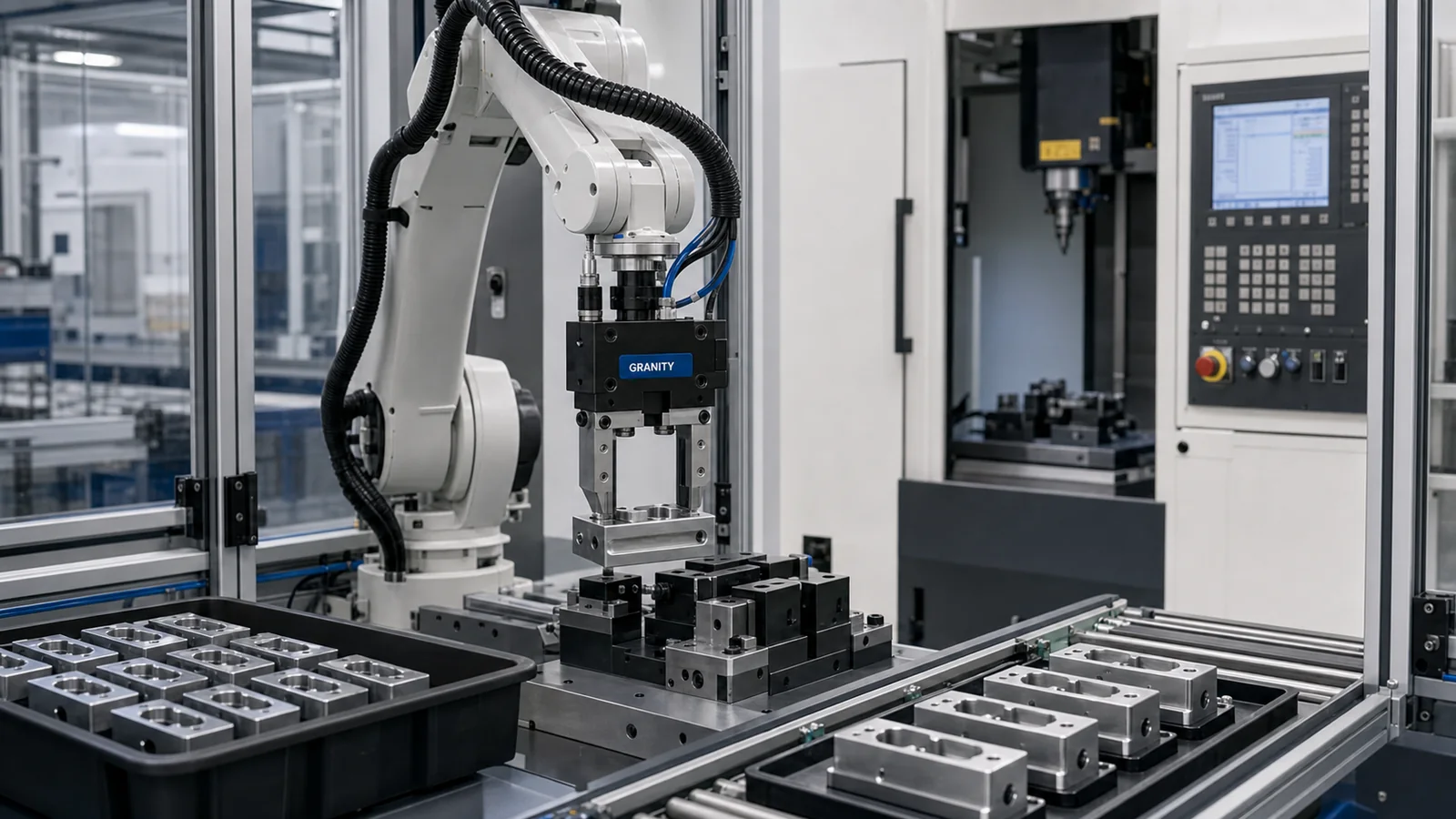
Define part presentation, grip surfaces, machine access and confirmation signals before committing to robot-side hardware.
5. Part presentation is not secondary
Input presentation may involve trays, conveyors, pallets, feeders, bins or manual staging. The best gripper choice changes when parts arrive nested, stacked, randomly oriented or precisely located. For a first automation project, stable part presentation often reduces risk.
Teams sometimes focus on robot and gripper selection while leaving part presentation unresolved. This can lead to extra vision requirements, complex recovery logic and inconsistent cycle behavior. Define presentation early.
6. Confirmation and error handling
Automation needs confirmation. The system may need to know that a part was picked, placed, clamped, machined, unloaded and moved to the correct output. Sensors, machine signals, gripper feedback and program logic all contribute to reliability.
Ask what happens when a pick fails, a part is missing, a door does not open, a fixture is not clear or a machine alarm occurs. A project plan should include normal operation and recovery behavior.
7. Fixture and workholding coordination
Machine tending may require workholding changes. The fixture must allow robot access, repeatable part location and reliable clamping. Zero point systems or modular fixtures may support faster setup or repeatable loading, but only when they fit the machine and workpiece strategy.
Coordinate gripper, workholding and machine interface decisions together. Treating them as separate purchases increases the risk of integration gaps.
8. Cycle time should be measured as a system
Cycle time includes robot travel, door motion, gripping, machine clamping, part confirmation, machine cycle, unloading, inspection and return motion. Reducing one motion by a small amount may not matter if the bottleneck is machine time or part presentation.
Before buying hardware, identify the current process time and the target improvement. This helps determine whether the project is about labor reduction, consistency, machine utilization, safety, shift extension or flexible production.
9. What to include in the first inquiry
Send the machine type, workpiece drawing or image, raw and finished part states, material, approximate mass, part presentation method, desired output location, available robot or planned robot, cycle target, quantity, timeline and whether CAD review is required.
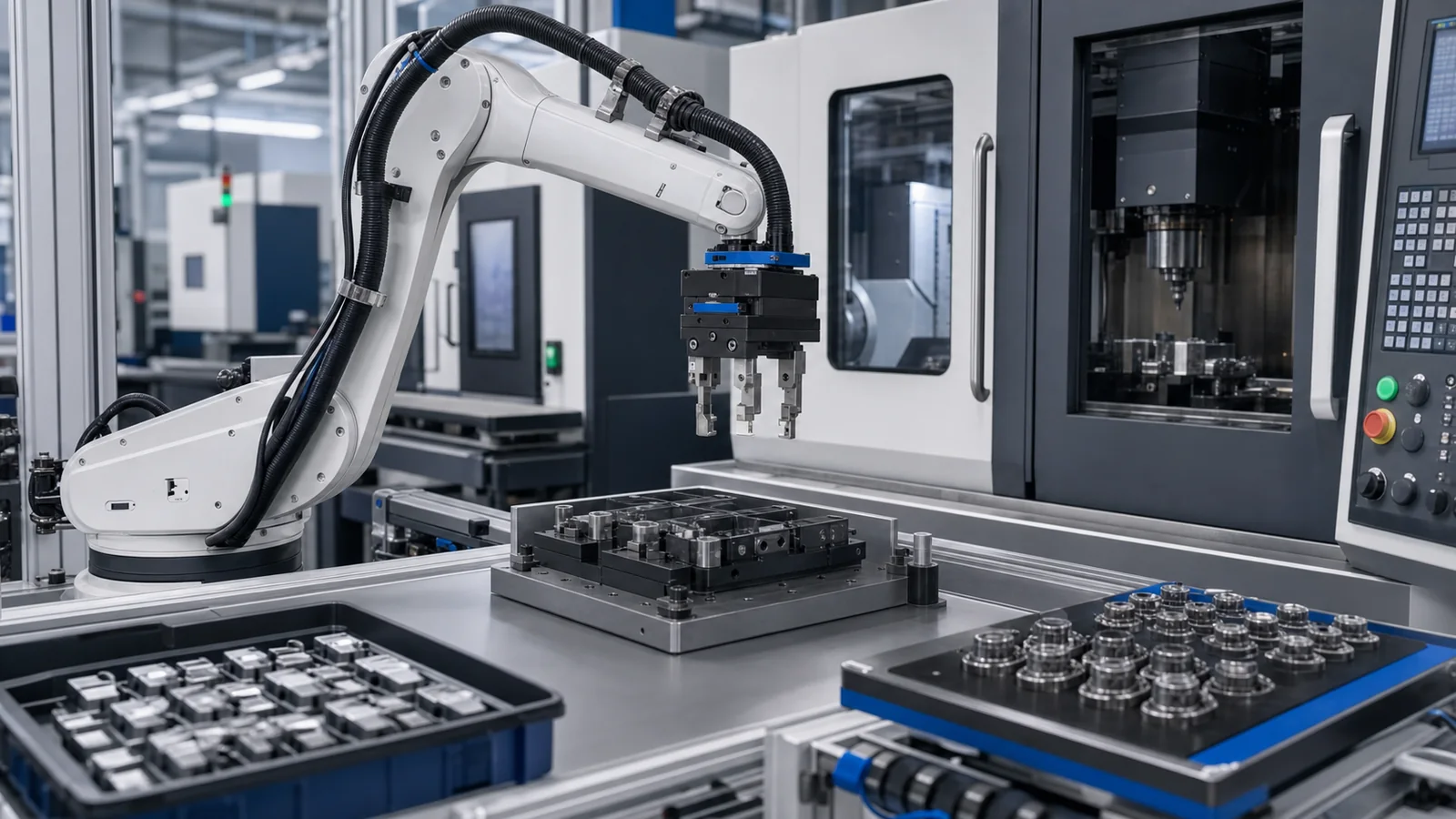
Keep the first inquiry tied to one machine, one workpiece family and one measurable handling problem before expanding scope.
10. Practical first-step approach
A strong first project often starts with a well-defined part family, stable presentation, clear machine signals and a manageable number of variants. It should have a clear business reason and a realistic technical scope. More advanced features can follow after the base workflow is stable.
11. CAD files for early engineering review
CAD is valuable in machine tending because the robot, gripper, tool stack, fixture, machine door and part presentation all interact physically. A CAD file should not be requested only as a download; it should support a specific review task such as reach, collision, jaw clearance, tool length or station layout.
When preparing a CAD request, include the product family, target workpiece, machine type and intended review purpose. If the robot model is known, provide it. If the machine envelope is not available, share photos or a simplified sketch. The goal is to use CAD to reduce integration uncertainty, not to create a false sense of final selection.
12. Buyer and management expectations
Management teams often ask what the automation will save. The answer should be based on the current process, not a generic automation claim. Teams should document current labor steps, machine waiting time, setup patterns, quality issues, safety concerns and target production volume. This helps separate real value from optimistic assumptions.
Buyers should support the engineering team by collecting complete project details before asking for final pricing. A quote request with only “robot gripper for CNC loading” will require additional clarification. A request with workpiece data, machine context, presentation method and project timing can move faster.
13. Integration responsibility
Machine tending usually involves several parties: customer engineering, machine supplier, robot integrator, gripper supplier, fixture designer and sometimes a distributor. Clarify who owns the robot program, fixture design, safety review, machine interface, end effector and acceptance testing. Without ownership clarity, simple technical issues can become schedule delays.
GRANITY can support product and engineering discussion, but the full cell must be coordinated by the responsible integration team. A good inquiry identifies where GRANITY support is needed and where the customer or integrator already has responsibility.
14. From concept to RFQ
Move to RFQ when the task, workpiece, machine, product family, quantity and timing are clear enough for quotation review. If the concept is still uncertain, start with engineering support. If the product family is clear but CAD is needed for layout review, request CAD and include the project details.
This staged approach keeps the conversation efficient. It prevents premature pricing requests while still helping active projects move forward.
15. What a first-market validation project should prove
For a company evaluating a first machine tending project, the initial goal should be production learning as much as hardware selection. The project should prove that parts can be presented consistently, picked securely, loaded without collision, confirmed by the machine and recovered when something goes wrong. These lessons are more valuable than a polished concept that has not been tested against real operating behavior.
When GRANITY supports early discussions, the focus is therefore on application clarity, suitable product-family direction and next-step readiness. If the project needs pricing and timing, a quote request is appropriate. If the project needs layout or grip review, engineering support should come first.
Conclusion
Machine tending is an application system, not a single product purchase. The most useful engineering inquiry describes workpiece flow, machine access, gripping strategy, confirmation needs and commercial goals. With that context, GRANITY can help identify the product family, CAD file requirement or quotation information to review first. This makes the first discussion more concrete for engineering and purchasing teams, especially when schedule pressure makes early clarity important for launch decisions and execution.
Recommended next steps
Start from industry scenarios and match machine tending requirements to product families.
Open General AutomationCompare gripping, automation and workholding modules before preparing quote details.
Browse ProductsUse engineering support when workpiece flow, machine access or CAD file requirements are not final.
Contact EngineeringPreparing a machine tending project?
Share your machine and workpiece context for engineering review.
Contact EngineeringRequest a Quote